

Precise Video Annotation: Crafting Your Visual Narrative
Turn raw video footage into structured, useful data for computer vision and machine learning applications. Our Video Annotation Services help identify objects, actions, movements, and important visual elements across video frames.
From object detection and tracking to segmentation and keypoint labeling, we create datasets based on your project requirements and annotation guidelines.

Video Annotation
Video contains information that changes from one frame to the next. Objects move, scenes change, and important events can occur within seconds. Proper annotation helps machine learning models understand these visual patterns over time.
Our Video Annotation Services for Machine Learning cover object labeling, tracking, segmentation, keypoints, lines, and frame classification. We follow defined labeling instructions to keep annotations consistent across video sequences.
Whether you are preparing data for autonomous systems, retail analytics, robotics, sports analysis, or other computer vision applications, the annotation approach can be customized around your dataset.
What We Do
Our video annotation workflow is built around the specific requirements of your project. We can label objects across frames, identify movements, mark important points, trace boundaries, and classify selected video frames.
Before annotation begins, your classes, attributes, frame requirements, and labeling rules can be clearly defined. This helps reduce inconsistencies when the same object appears across multiple frames.
Our Custom Video Annotation Services can support both specialized datasets and larger annotation requirements, with quality checks focused on label accuracy, consistency, and completeness.

type of Video Annotation Services

Bounding Boxes Annotation
Bounding box annotation identifies objects by placing rectangular boxes around them within video frames. It is commonly used for object detection and tracking applications.
Vehicles, pedestrians, products, animals, machinery, and other defined objects can be labeled according to your project guidelines. Consistent object identification across frames helps create useful datasets for computer vision models.
Polygon Annotation Annotation
Polygon annotation is suitable for objects where a rectangular box does not accurately represent their shape. Multiple points are used to follow the visible boundaries of an object.
This method can be applied to pedestrians, vehicles, road infrastructure, products, buildings, and other irregular shapes. Our Video Annotation Services can follow project-specific polygon guidelines to maintain consistent object boundaries throughout video sequences.
Semantic Segmentation Annotation
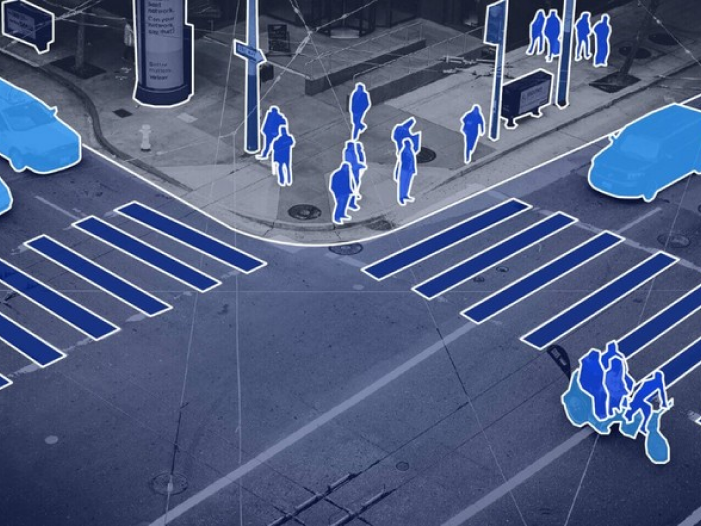
Semantic segmentation provides pixel-level labels to distinguish different regions within a video frame.
For example, a road-scene dataset may separate roads, vehicles, pedestrians, buildings, sidewalks, and vegetation into different classes. This gives computer vision models more detailed information about the visual environment.
Keypoint Annotation
Keypoint annotation marks specific points on people, objects, or other visual elements. For human movement analysis, keypoints may represent shoulders, elbows, wrists, hips, knees, and ankles across video frames.
This type of labeling can support pose estimation, gesture recognition, sports analysis, human activity recognition, and other computer vision applications


Line & Polyline Annotation
Line and polyline annotation is used to identify paths, lanes, boundaries, and other linear elements within video footage.
Road-lane annotation is a common example, where individual lanes need to be traced across changing frames. Similar labeling can be used for roads, pathways, pipelines, boundaries, and other linear structures.
Frames Classification Annotation
Frame classification assigns a category or specific attribute to individual frames or selected sections of a video.
Frames may be classified according to scene type, environment, lighting, weather, object presence, activity, or other project-defined criteria. This approach is useful when models need to distinguish between different visual situations or identify particular events.

FAQ's - Frequently Asked Questions
What is video annotation and why is it important for AI?
What types of video annotation techniques are commonly used?
Which industries benefit from video annotation services?
How does accurate video annotation improve AI model performance?
How to Change my Photo from Admin Dashboard?
Why should businesses outsource video annotation services?
Exceptional Services and Creative Solutions for Expandable Progress
One Tech Solutions is dedicated to providing top-notch services that stimulate creativity and open the door for scalable advancement. Our expert masterminds are prepared to assist you on your path, making sure that each action you do results in achievement.
More Services

Text Annotation Collection
We are proficient at text annotation because we leverage our knowledge of linguistics and natural language. Our community handles accurately labeling content in multiple languages. We offer text classification, annotation, & entity labeling services, making your AI training seamless.

Audio Annotation Collection
Use our audio annotation services to improve applications that use voice recognition. To gather and annotate audio data for machine learning, we work with skilled linguists, native speakers, and committed project managers, guaranteeing accuracy and quality.

Image Annotation Collection
Rely on our skilled team to source, annotate, and prepare images for your machine-learning needs. Our meticulous tagging enhances your computer vision models, and with help of annotation enabling them to effectively recognize and process visual data.
Quality Assurance
Our focus is on providing premium datasets that are specifically designed to enhance your AI models. We are prepared to fully handle any data concerns as your dependable partners. If your data doesn’t meet your expectations, we’ll enhance it, no questions asked – and at no extra cost.