

Healthcare AI is moving beyond simple prediction models. Today’s systems are expected to work with medical images, clinical text, physiological signals, electronic health records, and other forms of patient data. That shift is creating a much bigger challenge: building datasets that are diverse, accurately labeled, privacy-conscious, and useful in real clinical environments.
For businesses developing healthcare AI products, AI data collection for healthcare is therefore becoming a strategic part of model development rather than a preliminary data-gathering exercise.
In 2026, three areas are particularly important: multimodal healthcare data, synthetic data, and high-quality expert annotation. Together, they are changing how organizations prepare data for medical AI.
Why Healthcare AI Needs Better Data in 2026
A sophisticated AI model is only as reliable as the data used to develop and evaluate it. Healthcare makes this especially challenging because patient populations, clinical practices, equipment, terminology, and data formats can vary significantly between institutions.
Research has highlighted the shortage of high-quality annotated healthcare datasets, including datasets that adequately represent specific populations. Multimodal clinical data, including imaging and other information collected during patient care, can provide valuable resources when properly curated and annotated.
For businesses, collecting more data isn’t necessarily the answer. The focus is increasingly shifting toward data quality, diversity, traceability, and clinical relevance.
Multimodal Data Is Becoming Central to Healthcare AI
Healthcare information rarely exists in a single format.
A patient’s clinical picture might involve an X-ray, MRI scan, pathology image, physician notes, laboratory results, ECG signals, and structured EHR information. AI systems capable of connecting these different modalities can potentially develop a more complete understanding of a clinical scenario.
Recent research describes a broader shift toward foundation models capable of supporting multiple biomedical imaging tasks rather than narrowly focused models.
This creates new requirements for Healthcare AI Data Collection Services. Organizations may need to collect and organize:
- Medical images such as X-rays, CT scans, MRIs, and ultrasound
- Pathology and microscopy images
- Clinical notes and medical documents
- Speech and conversational healthcare data
- ECG and other physiological signals
- Structured and unstructured EHR data
- Image-text and other cross-modal datasets
The challenge is ensuring that these sources can be connected meaningfully while maintaining appropriate privacy, consent, provenance, and quality controls.
Synthetic Data Is Moving From Experiment to Practical Tool
Healthcare organizations often face a difficult trade-off. AI developers need large and diverse datasets, but real patient data can be difficult to access because of privacy, governance, availability, and data-sharing constraints.
Synthetic data can help fill some of these gaps.
Synthetic healthcare data is generated rather than directly collected from patients. Depending on how it is created and validated, it can be used to augment datasets, simulate uncommon scenarios, explore underrepresented populations, or support early model development.
Research has identified potential applications across medical imaging, clinical research, and other biomedical areas, while also emphasizing the need to assess quality, bias, privacy, and representativeness.
The important point is that synthetic data shouldn’t automatically be treated as a replacement for real-world healthcare data.
A stronger approach is often to use synthetic data alongside carefully curated real data, followed by validation against independent real-world datasets. Recent medical imaging research has specifically emphasized external evaluation because synthetic datasets can introduce artifacts or amplify distributional differences.
Annotation Quality Matters as Much as Data Volume
Collecting thousands or millions of healthcare records doesn’t automatically produce a useful AI training dataset.
The data must be labeled correctly.
This is where Healthcare Data Annotation Services become critical. Depending on the AI application, annotation can include identifying abnormalities in medical images, labeling clinical entities in text, segmenting anatomical structures, classifying conditions, or linking information across modalities.
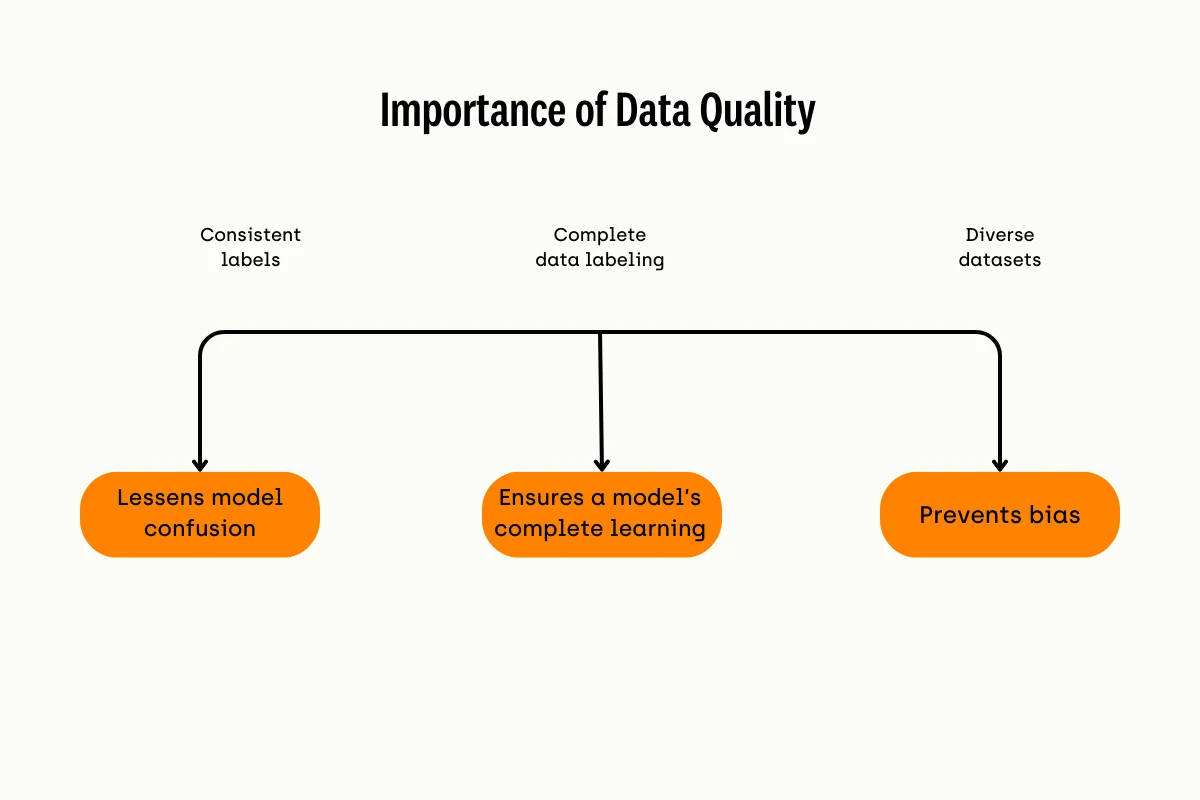
For example, an imaging dataset may require specialists to identify and segment a lesion rather than simply assigning an image-level diagnosis. A clinical NLP project might require annotators to identify symptoms, medications, diagnoses, or relationships between medical entities.
High-quality annotation generally requires:
- Clear annotation guidelines
- Domain-specific expertise
- Multiple levels of quality review
- Consistent labeling standards
- Inter-annotator agreement checks
- Ongoing quality monitoring
A Data Annotation Company supporting healthcare projects should therefore understand more than generic labeling workflows. The annotation process needs to reflect the clinical purpose of the dataset.
Text Annotation Is Becoming More Important
Medical AI isn’t only about images.
Large language models and multimodal systems are increasing demand for structured, high-quality clinical text. This includes physician notes, radiology reports, discharge summaries, medical conversations, and other healthcare documentation.
Text Annotation Services for AI can help transform unstructured clinical language into training data by labeling entities, relationships, intent, clinical concepts, and other information required for a particular model.
For example, a healthcare NLP project might annotate:
“The patient was prescribed metformin for type 2 diabetes.”
The annotation could identify the medication, condition, and relationship between them.
For organizations developing clinical AI assistants, information extraction systems, medical search tools, or healthcare language models, this structured supervision can be highly valuable.
Expert-in-the-Loop Workflows Are Becoming Essential
Automation can accelerate data preparation, but healthcare is a domain where accuracy matters.
AI-assisted annotation can help pre-label large datasets and reduce repetitive manual work. Human reviewers can then verify, correct, or reject those labels.
This creates a practical workflow:
Data collection → preprocessing → AI-assisted labeling → expert review → quality assurance → dataset release
The balance between automation and human oversight will vary by project. A simple classification task may require less manual review than a complex medical image segmentation project.
The goal isn’t to eliminate human involvement. It’s to make expert time more efficient while preserving the quality of the final dataset.
Healthcare Data Collection Companies Must Focus on Diversity
A dataset can be technically large and still perform poorly in the real world if it doesn’t represent the populations or environments where the AI system will be used.
Differences in age, sex, geography, ethnicity, clinical setting, medical equipment, disease prevalence, and image acquisition protocols can all influence model performance.
This is why AI Data Collection Companies need to think beyond sample volume.
For example, collecting chest X-rays from a single hospital may produce a consistent dataset, but it may not represent the variation an AI system encounters across different hospitals, devices, populations, or regions.
A strong collection strategy should therefore consider:
- Population diversity
- Geographic diversity
- Clinical environments
- Device and acquisition differences
- Rare and underrepresented cases
- Data quality and completeness
- Consistent metadata and provenance
Privacy and Governance Cannot Be an Afterthought
Healthcare datasets contain highly sensitive information. Data collection and annotation workflows therefore need appropriate privacy and governance controls from the beginning.
Synthetic data can reduce some barriers to data access, but it does not automatically eliminate privacy or quality concerns. Research has highlighted risks such as re-identification, memorization, bias, and poor representativeness in synthetic healthcare data.
WHO’s 2026 work on responsible AI in health also identifies fragmented and biased datasets, governance gaps, accountability, and transparency as important barriers to responsible healthcare AI adoption.
For businesses, this means data governance should be part of the project architecture rather than something addressed after annotation is complete.
Choosing the Right Healthcare AI Data Partner
For businesses building medical AI products, selecting a data partner requires more than comparing annotation costs.
Look for a provider that can support the complete data lifecycle, including collection, preprocessing, annotation, validation, and quality assurance.
Key questions include:
- Can they collect the specific healthcare data your model requires?
- Do they have experience with medical image and text annotation?
- How do they measure annotation quality?
- Can they support expert review?
- How do they handle sensitive healthcare information?
- Can the workflow scale as the dataset grows?
- Can they support both real and synthetic data workflows?
- How is data provenance maintained?
The right partner should be able to adapt the workflow to the model’s actual requirements rather than applying the same annotation process to every project.
What Businesses Should Expect From Healthcare AI Data in 2026
The healthcare AI data landscape is becoming more sophisticated. The focus is moving from simply acquiring large datasets toward creating AI-ready datasets that are diverse, well-annotated, traceable, and representative of real-world conditions.
Multimodal data will continue to expand the range of information AI systems can process. Synthetic data can help address scarcity and augmentation challenges when carefully validated. Meanwhile, expert annotation remains essential for converting raw healthcare information into reliable training data.
For organizations developing healthcare AI, the competitive advantage may not come from having the largest dataset. It may come from having the right data, labeled correctly, with enough diversity and quality to support trustworthy model development.
Build Better Healthcare AI With Better Data
Developing reliable healthcare AI starts with a strong data foundation. From Medical AI Data Collection Services to expert annotation and quality assurance, the right workflow can help businesses create datasets that are ready for demanding AI applications.
One Tech Solutions can help businesses plan and execute healthcare data collection and annotation workflows tailored to their AI requirements.
Connect With Us to discuss your healthcare AI data requirements.